
Essay · Article
What "La Dolce Vita" Taught Me About Coffee
The sweetness we keep missing.

FXVIIRGINIA | Espresso Sommelier
Jun 07, 2026
There is a scene in La Dolce Vita that has remained with audiences for more than sixty years.
Not because of a particular camera movement. Not because of the technical quality of the lighting. Not even because of the plot itself. People remember it because there is a feeling, a way of looking at the world, a certain gravitational pull which touches something deep and wordless inside us. This, I suspect, is one of the reasons the movie starring Marcello Mastroianni and Anita Ekberg remains so fascinating decades later.
Great actors rarely communicate only what is happening in a scene. They reveal something about the world surrounding it. They provide context. Meaning. Perspective.

In the movie, Marcello Mastroianni is not simply a journalist drifting through Rome’s postwar excess. He is a man who knows how to be present in a room and how to make the air around him feel charged with possibility. Sylvia, played by Anita Ekberg, is not simply beautiful. She inhabits her own joy so completely that it becomes contagious, irresistible, almost unreasonable.
What Anita Ekberg Understood
Ekberg’s Sylvia asks, at one point in the film, what love is. It is a question with no good answer, asked with complete sincerity. And somehow, it lands not as naïveté but as a kind of radical openness: a willingness to meet the world on its own terms, without irony or defense.
Sylvia, wading into the Trevi Fountain at dawn, is not performing for anyone. She is simply following the feeling. And there is something in that image, perhaps her unguarded joy or her complete indifference to self-consciousness, that captures what it looks like when a person has started opening herself to the world and tried to be honest with herself and herself only.

What Marcello Represents
Marcello appears as intelligent, charming, and sensitive. He is capable of recognising beauty and being touched by it. And yet, in every scene, something prevents him from fully surrendering to it. He is always, in some essential way, a spectator of his own life.
I would be tempted to say that he represents a particular kind of modern man: educated, restless, but still vaguely dissatisfied. A man who has access to everything the world considers desirable and finds, upon reaching it, that it does not quite deliver what was promised.
Not because the world has failed him, but because he has never learned to be still enough to receive it. His tragedy is not that La Dolce Vita is unavailable to him. It is that it is available constantly, in every room he enters, and he cannot stop moving long enough to let it in.
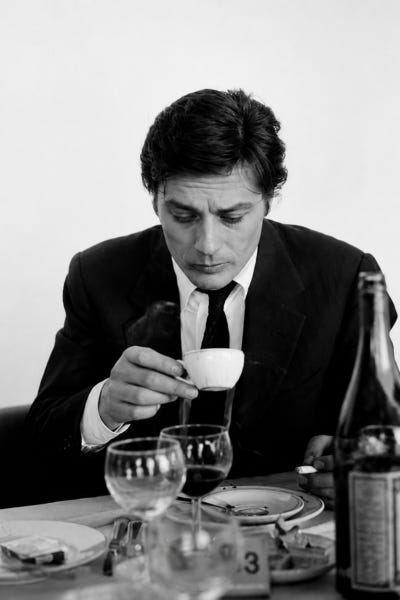
Fellini understood that this was not only Marcello’s weakness. It was something more structural to society in Italian post was: a disposition toward the next thing that had become so ingrained it was no longer a choice. Marcello does not decide to miss the moment. He simply never quite catches it. And by the final scene, standing on that beach at dawn, watching a girl call to him across the water, the distance between what he is and what he might have been has become permanent.
Two Ways of Being in the World
Placed side by side, Sylvia and Marcello are less a romantic pairing than a philosophical one. Fellini is not interested in whether they end up together. He is interested in what they represent: two entirely different relationships with experience itself.
Sylvia moves through the world as though it were made for her delight. Not out of vanity or entitlement, but out of a genuine willingness to receive whatever each moment offers. She does not filter experience through self-consciousness or logical calculation. When she wades into the fountain, she is not thinking about how she looks wading into the fountain. She is simply in the water, in the night, in the feeling. She is, in the truest sense, there.
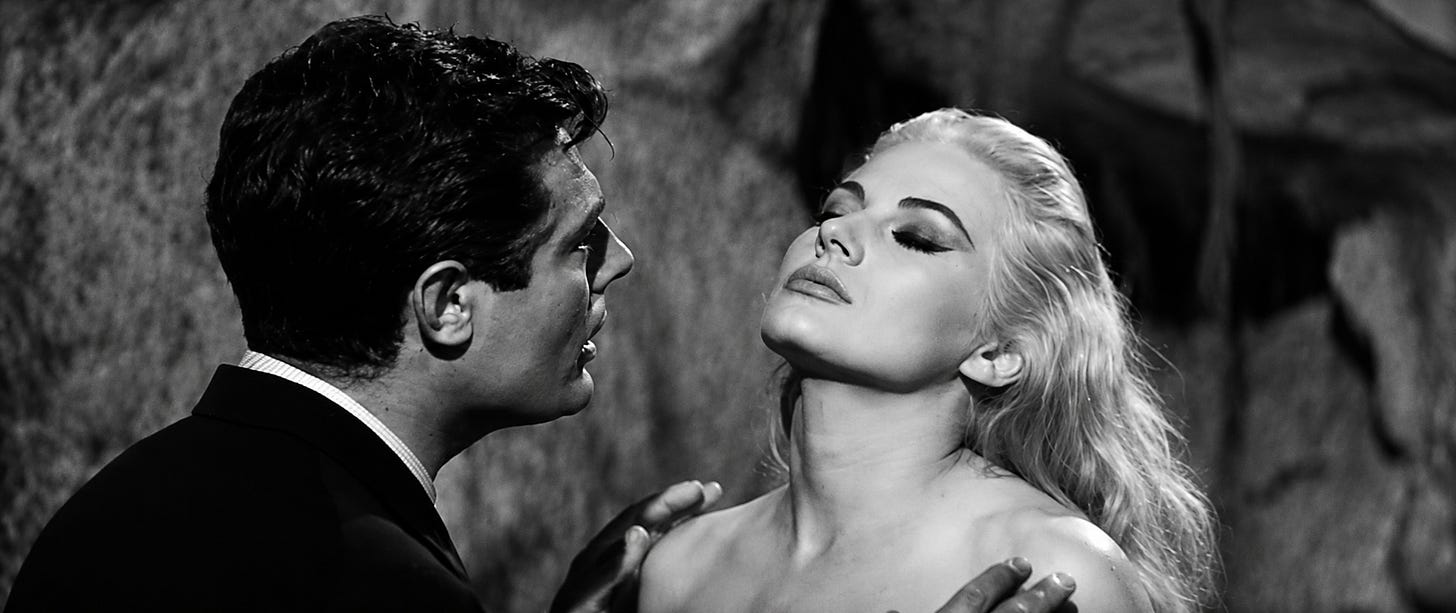
Marcello, instead, is always almost there. He is magnetically and helplessly drawn to Sylvia, precisely because she embodies what he cannot access in himself. Standing beside her in the fountain, for a brief moment, he seems close to living the moment in its fullness. The camera lingers on his face: something opens. But it does not last. It never lasts. By morning, the spell has broken, the city reasserts itself, and Marcello is once again in motion: toward the next thing, the next distraction, the next room where he hopes the sweet life might finally be waiting.
This is the tension that makes the film so enduring. Sylvia shows us what full presence looks like. Marcello shows us how easily, how habitually, we turn away from it. Between them, Fellini maps the full distance between a life that is felt and a life that is merely lived.
And leaves us to decide, quietly, which one we recognise in ourselves.
What La Dolce Vita Has to Do With Coffee
With a mixture of affection and melancholy, Federico Fellini called his film La Dolce Vita (or “The Sweet Life”) with the magnificent intention to represent on screen that the sweetness of life is real, but it often goes unnoticed.
What makes the film feel so contemporary is that Marcello no longer seems like a uniquely Italian character from 1960. He feels familiar. His restlessness has become our own. We move through the world too quickly, too defended against the possibility of being genuinely moved by something as large as a fountain at 4 am or as small as a cup of coffee on a Tuesday. It seems that we are always arriving somewhere, but never quite there.
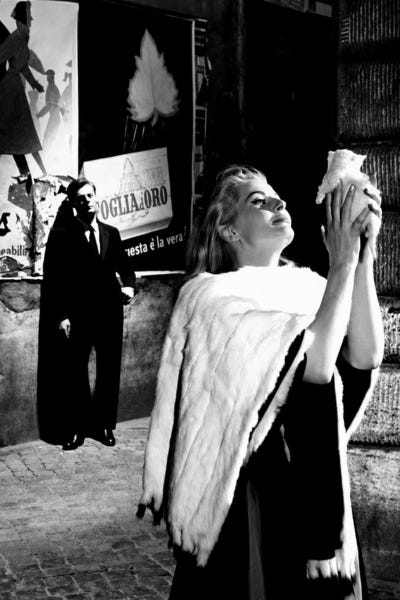
On the contrary, with the character of Sylvia, Fellini suggests that the sweetness of life was never very far away. It was never hidden in some extraordinary future moment. It has always been closer than the next party or the next fountain. It was right there in the ordinary.
Perhaps that is what Sylvia understood and Marcello never quite did.
The sweet life is not something waiting for us in the future. It exists only in the moment we are willing to fully inhabit. Just like your cup of coffee in the morning. Waiting, as it always has been, for someone to notice.
Or read it elsewhere