
Education · Article
The Anatomy of a Coffee Cherry
Before it becomes coffee, it is a fruit.

FXVIIRGINIA | Espresso Sommelier
Aug 11, 2026
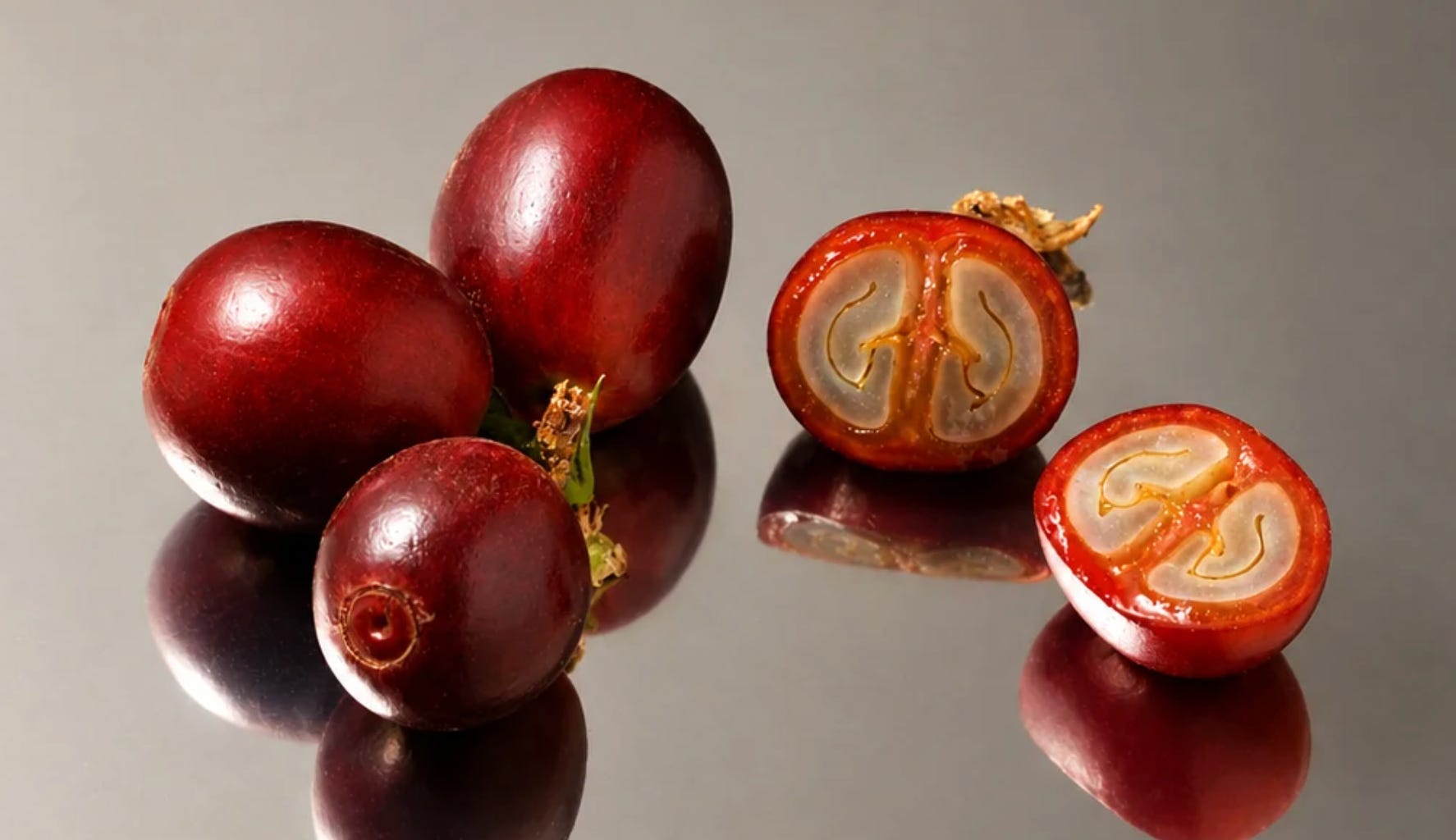
Yes, your morning starts with a fruit.
They say you should have at least one portion of fruit a day.
Good news: your morning coffee almost counts.
You might be surprised, but I’m not kidding. Coffee beans are not actually beans, but rather they are seeds. And before they reach your Moka in the early morning, those seeds sit at the centre of a fruit called the coffee cherry.
So, technically, your espresso has been trying to contribute to your five-a-day all along (just don’t tell your doctor).
But now, let’s cut one open.
First: What is actually inside a coffee cherry?
Starting from the outside and working our way in, we encounter several different layers:
Far from wanting to turn this into a biology lesson, understanding the key characteristics of these layers actually matters. That is because the final product in your cup is, in many ways, the story of what happens to them at each stage of processing.
Washed, natural, honey, fermentation, drying, hulling…
Perhaps these terms that can sound unnecessarily technical, but they will start making much more sense once you understand the fruit.
1. Skin: the exocarp
The first thing you see is the skin, technically called the exocarp.
Coffee cherries begin their lifecycle with an instantly recognisable green colour and, depending on the variety, commonly ripen into shades of red, yellow or orange.
Think about a strawberry. I assume you would agree that an underripe, pale strawberry and a perfectly ripe, sweet red one definitely do not taste the same.
Coffee is no different.
As with other fruits, the moment at which a coffee cherry is picked can significantly affect the flavor that eventually reaches your cup. Ripeness influences the sugars and other compounds present in the fruit, which is why harvesting ripe cherries is such an important part of producing high-quality coffee.
2. Pulp: the mesocarp
Underneath the skin comes the pulp, or mesocarp, which can taste surprisingly sweet.
It feels obvious once you remember that coffee is a fruit, but it is surprisingly easy to forget when the only coffee we normally encounter is brown, roasted and intensely aromatic.
Which raises another question:
And that becomes especially interesting with the next layer.
3. Mucilage: where processing gets interesting
Around the seeds sits a sticky, sugar-rich layer called mucilage.
If you have ever wondered why coffee people become so animated when discussing fermentation, this is one of the reasons. The sugars and organic material surrounding the seeds provide a substrate for microorganisms during fermentation. Producers can manipulate how the fruit is removed, how long fermentation lasts and how the coffee is dried — which are classified into:
- Natural process, when the coffee cherry is dried with the fruit intact;
- Washed process, when the skin and pulp are removed and the remaining mucilage is typically broken down and removed before drying;
- Honey processes leave varying amounts of mucilage around the seed during drying.
So when you see one of these proccesses written on a specialty coffee bag, you are being told something about what happened to the fruit surrounding the seed.
4. Parchment: the endocarp
Keep moving towards the centre and you reach the parchment, or endocarp.
Think of it as a protective shell wrapped around each coffee seed.
An important distinction here: coffee in parchment is not yet the green coffee you see arriving at a roastery. The parchment still needs to be removed (typically through a process called hulling) before we reach the green coffee seed.
5. Silver skin
Almost there.
Under the parchment sits an extremely thin membrane called the silver skin.
Have you ever seen the light, papery flakes flying around during coffee roasting? Part of what you are seeing is chaff, much of it derived from this thin layer separating from the coffee during roasting.
And underneath it, finally, is what we have been looking for.
6. The “bean” that isn’t a bean
At the centre of the cherry are usually two coffee seeds.
These are what we call coffee beans. The two seeds normally develop facing one another, which explains the characteristic flat side of many coffee beans.
The Key Question
As discussed in this short article, coffee starts as a fruit made of skin, pulp, mucilage, parchment, and silver skin. Layer by layer, most of that fruit is removed until what remains is the green coffee seed.
But that leaves us with the million-dollar question:
Well, I would love to give you a beautifully researched botanical explanation. The reality is much less sophisticated as they are called beans because they look like beans.
… and the coffee “bean” has been getting excellent PR for centuries.
Or read it elsewhere