
Essay · Article
The Hidden Rhythm of Coffee
Biennial bearing cycle: why coffee has "good years" and "bad years".

FXVIIRGINIA | Espresso Sommelier
Aug 05, 2026

Every few years, headlines announce that Brazil is heading for a record coffee harvest.
Almost as predictably, production declines the following season. To the casual observer, this may look like poor forecasting or simply bad luck.
In reality, it is one of the oldest and most fascinating biological characteristics of the coffee tree: the “biennial bearing”, also known as “the biennial production cycle”.
Coffee trees have an energy budget
The natural alternation between high-yield and and low-yield production years is rooted in the biology of the coffee tree. Unlike wheat or maize, the coffee tree is not planted every year.
In botanical terms, coffee is a perennial crop - from the Latin per ("through") and annus ("year") - defined as a plant that lives for more than two growing seasons and continues to grow and reproduce without replanting. This fundamental characteristic shapes the physiology of the coffee tree and, ultimately, the dynamics of global coffee production.
Differently from annual crops, which effectively begin each season with a clean slate, a coffee tree must continuously allocate its finite resources between two competing objectives: producing this year's harvest while simultaneously preparing for the next.
In the the language of the coffee industry, these alternating seasons are known simply as on-years and off-years. During an on-year, a tree invests enormous amounts of energy into flowering, fruit development and bean filling.
As financial people like to say, there is “no free lunch”, meaning that : every additional cherry comes at a physiological cost. The heavier the crop on one year, the fewer resources remain for vegetative growth and, more importantly, for the formation of the flower buds that will become the following year’s harvest. This is why coffee harvest often resembles a pendulum rather than a straight line.
More than a Biological Curiosity
Far from being just a botanical curiosity, the biennial cycle can shift global coffee supply by several million bags. An on-year typically eases supply pressures and weighs on futures prices, while an off-year tightens the market, supporting prices and reshaping expectations across the entire coffee value chain. This intrinsic characteristic of the coffee tree is particularly important when assessing production in the world’s largest coffee-growing countries, especially Brazil.
Why?
Well, Brazil is not just another coffee producer. It accounts for roughly one-third of global coffee production and is the world’s largest producer of coffee, as well as by far the largest producer of arabica. When millions of Brazilian coffee trees move through the biennial cycle simultaneously, their collective biological rhythm becomes a major driver of global coffee supply.
As a result, the question of whether Brazil is entering an on-year or an off-year is not merely of agronomic interest. On the contrary, it is one of the first questions asked by traders, exporters, roasters and analysts trying to anticipate the direction of the global coffee market.
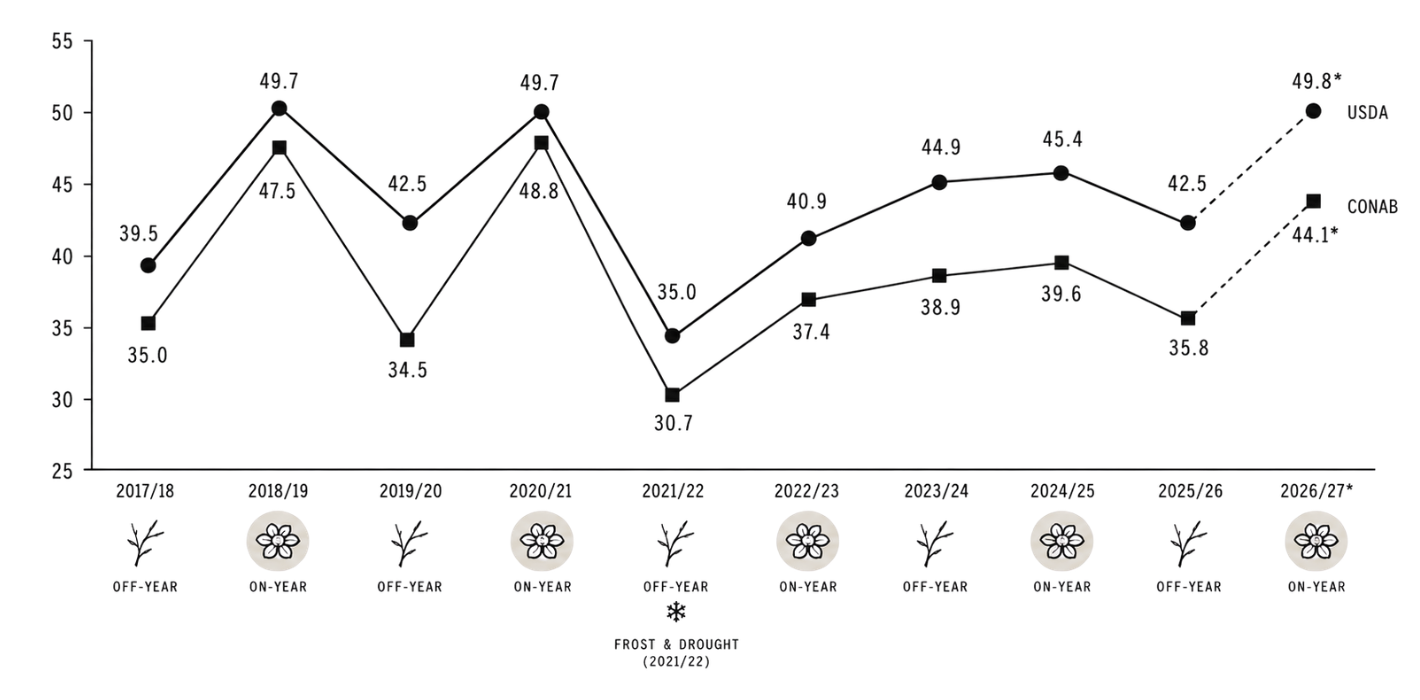
Recent harvests illustrate this pattern clearly. Following the strong 2024/25 crop of around 69.9 million bags, Brazil entered an off-year in 2025/26, with production estimates falling to around 63–65 million bags, largely reflecting the negative phase of the biennial cycle. For 2026/27, forecasts rebound sharply to 66.7 million bags (CONAB) or 71.9 million bags (USDA), once again driven by the return of a positive biennial year.
The picture becomes even clearer when we focus exclusively on arabica, the variety where biennial bearing is most pronounced. While Brazil’s total coffee production has become increasingly influenced by the rapid expansion of conilon (robusta), arabica continues to exhibit a more pronounced pattern of alternating on-years and off-years (Graph 1).
Graph 1: Brazil's Arabica Production and the Biennial Cycle
Can farmers reduce biennality?
Although biennial bearing is a natural characteristic of arabica coffee, it is not entirely beyond human control. Recent research shows that farmers cannot eliminate the cycle, but they can reduce its amplitude by helping trees recover more effectively after heavy production years.
Among the most effective practices are:
- balanced fertilisation to replace nutrients depleted during heavy harvests;
- pruning to stimulate new productive branches and avoid excessive fruit loads;
- shade management to reduce environmental stress and branch dieback;
- higher planting density to distribute production across a greater number of trees;
- cover crops to improve soil fertility, water retention and long-term plant health.
However, even the best agronomic practices cannot fully overcome the biology of the coffee tree. As a result, the production cycle remains one of the first variables analysts consider when assessing a Brazilian harvest.
Why everyone is talking about 2026
The renewed focus on Brazil’s 2026/27 crop stems largely from the country’s return to the positive phase of the biennial cycle.
CONAB currently forecasts production of 66.7 million bags, while the USDA projects 71.9 million bags. Either estimate would rank among the largest harvests in Brazilian history. Note, however, that biennal bearing is only part of the story.
Expanded planted area, several years of elevated coffee prices that encouraged investment and broadly favourable weather conditions have all reinforced expectations of an exceptional crop.
Or read it elsewhere